
SEMUDMEX Weekly Customs & Trade Intelligence Bulletin

Logistics

Mexico · United States · Canada · Asia · Global

Executive Strategic Brief | Week 16 | Wednesday 15-04-2026

This edition is intentionally built as a deep analytical document rather than a summary of events. Over the last two weeks, multiple developments across trade policy, industrial strategy, geopolitics and energy markets have converged in a way that fundamentally changes how international trade must be executed. The key takeaway is not that trade is slowing down, but that it is becoming structurally more complex, less predictable and increasingly conditioned by political and operational variables that go beyond traditional cost and efficiency models. Sources include USTR (NTE 2026), Reuters, IMF, WTO, UNCTAD, IEA, CANIETI and El Financiero, but the real value lies in understanding how these elements interact in practice.

I. USMCA – From Legal Framework to Operational Pressure System

Sources: USTR NTE 2026; El Financiero; U.S. trade policy positioning

The USMCA is entering a new phase where its importance will not be defined by its existence, but by the conditions under which it is enforced. The shift observed in the 2026 National Trade Estimate is not simply a change in tone; it represents a structural repositioning of Mexico within the U.S. trade narrative. By moving from describing Mexico as an operationally inconsistent environment to framing it as a restrictive one, the United States is effectively laying the groundwork for a more aggressive enforcement strategy. This includes greater scrutiny in rules of origin, stricter validation processes and less tolerance for interpretation gaps.

This shift is not isolated. It aligns with a broader global trend in which trade agreements are no longer static legal frameworks, but dynamic tools used to influence industrial outcomes. Under this logic, enforcement becomes a mechanism to reshape supply chains, rather than simply regulate them. This creates an environment where compliance is no longer a binary condition, but a continuous operational challenge that requires constant validation.

SEMUDMEX 360° View: The most relevant risk is not the renegotiation of the treaty, but its operational tightening. Companies will continue to depend on USMCA for market access, but the cost of maintaining eligibility will increase significantly. This creates a structural pressure point where compliance, cost and competitiveness begin to conflict.

II. Nearshoring – The Gap Between Narrative and Industrial Reality

Sources: CANIETI; UNCTAD; El Financiero

Nearshoring continues to be one of the most widely discussed themes in North American trade, yet its actual implementation reveals significant structural limitations. Mexico has positioned itself as a key destination for supply chain relocation, but its industrial base, particularly in high-value sectors such as semiconductors and advanced electronics, remains dependent on Asian inputs. This dependence is not marginal; it is foundational, and it cannot be eliminated in the short term without major investment and technological development.

The core issue lies in the mismatch between policy expectations and industrial capacity. Governments are pushing for rapid regionalization, while the private sector requires time to build the necessary infrastructure, supplier networks and technical capabilities. This mismatch creates operational stress, as companies are expected to comply with regional content requirements that may not yet be feasible from a sourcing perspective.

SEMUDMEX 360° View: Nearshoring is not a failure, but it is far from complete. The real risk lies in overestimating its maturity. Companies that assume regional supply chains are already self-sufficient may face cost overruns, compliance challenges and supply disruptions as they attempt to align policy expectations with operational reality.

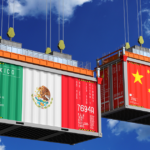
III. Mexico Between the U.S. and China – Structural Geopolitical Exposure

Sources: Reuters; global trade monitoring

Mexico’s role in global trade is undergoing a significant transformation. For years, it functioned as a relatively neutral manufacturing hub, benefiting from its proximity to the United States while maintaining access to global supply chains, particularly from Asia. This model is now under pressure as geopolitical tensions between the United States and China intensify.

The United States is actively seeking to reduce Chinese content within North American supply chains, while China is beginning to signal potential responses to restrictive measures. This creates a dual-pressure environment where Mexico is no longer simply a participant in global trade, but a strategic point of tension between two major economic powers.

SEMUDMEX 360° View: The neutrality of supply chains is disappearing. Companies must now evaluate sourcing decisions not only in terms of cost and efficiency, but also in terms of geopolitical alignment and exposure. This represents a fundamental shift in trade strategy, where political considerations become as important as economic ones.

IV. Energy and Hormuz – From External Factor to Core Trade Variable

Sources: IEA; Reuters

Energy markets have always influenced global trade, but recent developments have elevated their importance to a new level. The Strait of Hormuz, through which approximately 20% of global oil flows, remains a critical chokepoint. Any disruption in this region has immediate and widespread effects on energy prices, transportation costs and industrial inputs.

What makes the current situation particularly relevant is the speed at which these effects are transmitted into trade operations. Companies often adjust sourcing, pricing and logistics decisions in response to energy fluctuations, but these adjustments are not always reflected in their documentation and compliance processes. This creates a disconnect between operational reality and regulatory requirements.

SEMUDMEX 360° View: Energy volatility must be treated as an internal component of trade strategy. It directly affects customs valuation, margin stability and supplier selection. Failure to integrate energy considerations into compliance frameworks will result in hidden risks that materialize during audits or disputes.

V. Enforcement – The Shift Toward Execution-Based Risk

Sources: USTR; CBP trends; SAT practices

A critical transformation in the trade environment is the shift from regulatory expansion to enforcement intensification. Authorities are not necessarily introducing new rules, but they are applying existing ones with greater rigor. This includes increased data requirements, higher inspection rates and reduced tolerance for inconsistencies.

This shift changes the nature of compliance. Understanding the rules is no longer sufficient; companies must demonstrate consistent execution across all aspects of their operations, including documentation, valuation and traceability. The weakest link is often not legal interpretation, but operational discipline.

SEMUDMEX 360° View: The risk landscape has moved from regulation to execution. Companies that fail to align internal processes with external requirements will face increasing friction, even if they are technically compliant.

VI. Systemic Risk – The Accumulation Effect

The most important structural change is the transition from isolated risks to a systemic risk model. Tariffs, energy volatility, geopolitical pressure and industrial capacity constraints no longer operate independently. They interact and amplify each other, creating complex scenarios that are difficult to predict and manage.

This means that a disruption in one area, such as energy, can trigger cascading effects across supply chains, cost structures and compliance processes. Companies must therefore adopt an integrated approach to risk management that considers these interdependencies.

SEMUDMEX 360° View: The key challenge is not identifying individual risks, but understanding how they combine. This requires a shift from siloed decision-making to a coordinated strategy across functions.

VII. Global Trade Fragmentation – Growth Without Coherence

Sources: WTO; UNCTAD

Global trade volumes remain strong, but the institutional framework that supports them is weakening. The WTO’s limited ability to implement reforms has led to a more fragmented system, where regional agreements and unilateral measures play a larger role.

This fragmentation creates uncertainty, as companies must navigate multiple regulatory environments with different requirements and priorities. The same product may face different conditions depending on the trade corridor in which it is used.

SEMUDMEX 360° View: The global trade system is not collapsing, but it is losing coherence. Companies must adapt by developing corridor-specific strategies rather than relying on a single global approach.

VIII. SEMUDMEX Executive Conclusion

The overarching conclusion is that global trade is becoming more selective and more complex. Access to markets remains available, but the conditions for participation are becoming increasingly demanding.

Companies must transition from efficiency-driven models to resilience-based strategies. This involves strengthening compliance systems, maintaining flexibility in sourcing, improving visibility across supply chains and integrating geopolitical awareness into decision-making processes.

Those that can adapt to this environment will not only mitigate risk, but also position themselves to take advantage of emerging opportunities. In contrast, companies that continue to rely on outdated assumptions about trade stability will face increasing operational and financial pressure.

Read More →

SEMUDMEX Weekly Customs & Trade Intelligence Bulletin

Logistics

Mexico · United States · Canada · Asia · Global

Executive Strategic Brief | Week 15 | Wednesday 08-04-2026

I. United States – Selective Tariff Pressure

Sources: USTR NTE 2026; Reuters; IMF

The United States is moving toward a more selective and targeted use of trade enforcement tools. Rather than relying on broad tariff measures, current policy is focusing on specific sectors tied to national security and industrial competitiveness. This includes semiconductors, advanced manufacturing and strategic inputs, where enforcement is becoming more precise and less visible at a macro level.

SEMUDMEX View: This shift creates a risk environment that is harder to detect. Companies may appear compliant overall but still face exposure at the product level, particularly in sensitive sectors.

II. USMCA – Pressure on Mexico

Sources: USTR; El Financiero

The 2026 NTE reframes Mexico as a more restrictive trade environment, emphasizing increased documentation requirements and stronger enforcement capacity. This narrative shift is significant because it supports a more aggressive posture ahead of the USMCA review.

SEMUDMEX View: The risk is not treaty termination but stricter compliance thresholds. Companies should prepare for increased scrutiny in origin and customs processes.

III. Nearshoring – Structural Limitations

Sources: CANIETI; UNCTAD

Mexico’s dependence on Asia for semiconductor inputs highlights the limitations of current nearshoring efforts. While the country plays a role in assembly, advanced production capacity remains limited.

SEMUDMEX View: Nearshoring should be viewed as a gradual transition rather than a completed model. Hybrid sourcing remains necessary.

IV. Geopolitical Pressure

Sources: Reuters

Mexico faces increasing pressure from both the United States and China, creating a complex environment for supply chain decisions.

SEMUDMEX View: Supply chains must now account for political alignment, not just economic efficiency.

V. Energy Risk

Sources: IEA; Reuters

Energy volatility, particularly around the Strait of Hormuz, continues to impact global costs and logistics.

SEMUDMEX View: Energy is now a direct trade variable affecting valuation and margins.

VI. Global Trade Fragmentation

Sources: WTO; UNCTAD

Global trade remains strong, but governance is increasingly fragmented across regions.

SEMUDMEX View: Trade strategies must adapt to corridor-specific conditions.

VII. SEMUDMEX Executive Conclusion

Global trade continues to operate at scale, but execution has become more complex. Companies must adapt by strengthening compliance, maintaining supply chain flexibility and incorporating geopolitical awareness into decision-making. The ability to operate effectively in this environment will define competitiveness going forward.

Read More →

SEMUDMEX Weekly Customs & Trade Intelligence Bulletin

Logistics

Mexico · United States · Canada · Asia · Global

Executive Strategic Brief | Week 14 | Wednesday 01-04-2026

SEMUDMEX – Strategic Customs, Trade & Regulatory Advisory

This week’s edition is built around a sharper reality than the one that framed the previous bulletin: North American trade is no longer being shaped only by tariffs, but by a wider screening logic that combines customs enforcement, industrial policy, treaty revision, supply-chain traceability and geopolitical alignment. The practical consequence is that companies are being forced to manage three risks at the same time: first, a more aggressive customs environment; second, a tighter interpretation of regional integration under USMCA; and third, a widening gap between policy ambition and the actual industrial capacity of the region.

The underlying message for importers, exporters and nearshoring operators is not that trade is slowing down. Trade flows remain large and commercially attractive. What has changed is the cost of operating without precision. Documentation, origin, supplier mapping, customs value support and treaty eligibility are now strategic variables rather than back-office functions.

I. United States – Tariffs, litigation and enforcement after the court shock

Tariff refunds are turning into one of the largest customs execution processes in recent U.S. history

Source: Reuters reporting on CBP refund system progress, 06-03-2026 and 12-03-2026

Operational Explanation: What had initially been viewed as a legal dispute over tariff authority is now becoming a full administrative event. CBP acknowledged that it is developing the operational infrastructure to process refunds tied to tariffs invalidated by the courts. The estimated exposure is around USD 166 billion and the affected universe could exceed 300,000 importers. That scale matters because it implies not only refunds, but also a heavy review cycle involving historical entries, liquidation status, broker records, allocation disputes and audit trails. This is particularly significant for companies that treated tariff expense as closed historical cost. In reality, many of those entries may now need to be reopened, classified for recovery and documented with a level of precision that many organizations did not originally preserve.

SEMUDMEX Practical Risk Assessment: The risk is no longer primarily judicial; it is operational. Companies that fail to organize entry history, broker communication, refund ownership and support files early may lose value even if the legal basis favors them. For SEMUDMEX clients, this is a treasury issue, a customs issue and a governance issue at the same time.

The U.S. is not losing tariff power; it is redesigning the way it applies it

Source: Reuters reporting on new Section 301 investigations and replacement pressure after the court rulings, March 2026

Operational Explanation: A common mistake in the market is to assume that judicial limits on one tariff mechanism mean a broader retreat in U.S. trade pressure. The opposite appears to be happening. Washington is already evaluating other legal channels to preserve commercial leverage, particularly through Section 301 and sector-specific actions linked to industrial overcapacity, forced labor and strategic dependence. This matters because it shifts the tariff environment from broad blunt instruments toward more selective and politically calibrated tools. In practical terms, sectors tied to technology, advanced manufacturing, pharmaceuticals, batteries, minerals and Chinese-linked supply chains are likely to face more targeted pressure than general consumer categories.

SEMUDMEX Practical Risk Assessment: SEMUDMEX reads this as a change in architecture, not a reduction in intensity. Companies that continue budgeting tariff exposure as if the risk were broad and generic may miss where the real pressure is moving. Pricing, supplier qualification and contract drafting now need scenario analysis by sector, not just by country.

CBP’s operational changes in refunds and bonds are becoming financially material

Source: CBP / Federal Register notices on electronic refunds and electronic bond transmission; Reuters refund-system reporting

Operational Explanation: Changes such as ACH-based refunds and tighter digital bond validation may sound procedural, but they now sit directly at the intersection of customs, treasury and internal control. When refunds are processed electronically and bond validation becomes more rigid, small mismatches in account configuration, power of attorney, surety instructions or broker data can delay money, block entries or create internal disputes over who is entitled to recover what. For high-volume importers, this type of operational friction becomes expensive precisely because it is repetitive and difficult to detect until cash or cargo is already affected.

SEMUDMEX Practical Risk Assessment: SEMUDMEX considers this a high-probability, medium-to-high impact issue. It does not generate headlines, but it does generate leakage. Clients should be auditing ACH setup, refund reconciliation logic, bond sufficiency and broker/surety controls now, before the system becomes less tolerant of manual fixes.

II. USMCA – Mexico under a harder U.S. trade lens

The 2026 National Trade Estimate reclassifies Mexico from inefficient to restrictive

Source: USTR National Trade Estimate 2026; El Financiero coverage, 31-03-2026

Operational Explanation: The most important shift in the U.S. description of Mexico is conceptual. In earlier cycles, the emphasis was on delays, inconsistent criteria and operational inefficiency. The 2026 framing goes further: Mexico is presented as a more restrictive and enforcement-driven commercial environment. The report highlights higher information demands for import transactions, materially greater sanction exposure, and expanded customs powers to detain and seize shipments. It also brings in a broader industrial-policy concern, pointing to public procurement practices that reward local investment and infrastructure, and a stronger energy critique centered on shorter permit duration, logistics restrictions and state preference—especially where Pemex is involved. The mention of more than USD 2.5 billion in unpaid obligations linked to U.S. companies adds a financial-risk layer that goes beyond customs friction.

SEMUDMEX Practical Risk Assessment: SEMUDMEX does not read this as a routine annual complaint. It functions as a positioning document ahead of the USMCA review. The significance is that Mexico is no longer being framed merely as difficult to operate in, but as structurally biased and more interventionist. That gives the U.S. more room to justify stronger enforcement, deeper rules-of-origin scrutiny and potentially more aggressive use of treaty mechanisms.

Mexico is now caught between U.S. pressure to reduce Chinese exposure and Chinese pressure against Mexican tariffs

Source: Reuters reporting on Chinese response to Mexican tariff measures, 25-03-2026; broader U.S. discussions on Chinese content in Mexico, March 2026

Operational Explanation: For months, the central strategic question had been how far the U.S. would go in pushing Mexico to tighten regional content and reduce reliance on Chinese-linked supply chains. What is new this week is that China has also started signaling direct commercial pushback. That means Mexico is no longer only under pressure from Washington to harden its regional alignment; it may also face counter-pressure from Beijing when tariff or sourcing decisions materially affect Chinese exports into the Mexican industrial base. This matters especially for sectors such as automotive, electronics and machinery, where Mexico’s manufacturing success has often depended on combining Asian inputs with North American market access.

SEMUDMEX Practical Risk Assessment: SEMUDMEX sees this as a two-front trade risk. Companies with Asian sourcing and Mexican assembly should stop treating geopolitical exposure as an abstract concern. It is now a sourcing, origin, valuation and negotiation issue. Firms that cannot explain their China exposure cleanly will face pressure from one side or the other—and in some cases from both.

Mexico and Canada are defending the trilateral treaty, but the real outcome is likely stricter regional integration, not easier regional integration

Source: Reuters reporting on Mexico–Canada position and Mexican business feedback, 09-03-2026 and 12-03-2026

Operational Explanation: Mexico and Canada have made their position clear: they want the USMCA to remain trilateral and not slide into two bilateral relationships dominated by U.S. leverage. That political stance is reinforced by the Mexican private sector, which continues to view treaty stability as essential because such a high share of Mexican exports still goes to the U.S. market. The strategic implication, however, is not that the treaty will remain unchanged. The more realistic expectation is that it will survive, but under tighter conditions—more enforcement, more regional-content discipline and less tolerance for ambiguous origin structures.

SEMUDMEX Practical Risk Assessment: SEMUDMEX believes companies should stop preparing for treaty collapse and start preparing for treaty hardening. The correct question is not whether USMCA survives, but how demanding it becomes for firms trying to preserve preferential treatment.

III. Nearshoring – the semiconductor case reveals the region’s industrial gap

Mexico’s semiconductor dependency shows where nearshoring is still aspirational rather than operational

Source: CANIETI statements; El Financiero coverage, 01-04-2026

Operational Explanation: The semiconductor discussion is one of the most revealing indicators of the real state of North American reindustrialization. Mexico participates in a global semiconductor market worth more than USD 700 billion, yet its current position remains concentrated in assembly and lower-value integration stages. Industry representatives estimate that even substituting basic imports could take at least five years, while advanced production—such as wafers and higher-end chip manufacturing—remains outside domestic capability for now. This is not a minor industrial gap. It means that even if policy pushes for stronger regional content under a revised USMCA, the region may not be able to comply economically without higher costs or hybrid sourcing. The article is especially valuable because it highlights the practical nuance: some low-complexity components may indeed be localized, but the critical layers of the semiconductor chain remain dependent on Asia, particularly Taiwan, South Korea and China.

SEMUDMEX Practical Risk Assessment: SEMUDMEX reads this as the clearest proof that policy can move faster than industrial capability. Nearshoring is real, but incomplete. For clients in electronics, automotive and telecom-linked manufacturing, the winning strategy is not a simplistic ‘regionalize everything’ approach. It is a disciplined hybrid model: protect treaty eligibility where possible, but design sourcing around what the region can actually produce rather than what negotiators may wish it could produce.

The semiconductor issue is not just industrial policy; it is rules-of-origin policy in disguise

Source: CANIETI / El Financiero, 01-04-2026; USMCA review context

Operational Explanation: The article’s most important strategic point is that future rules of origin will determine where the region tries to attract activity and which components become politically sensitive. That means semiconductors are likely to move from being a supply-chain topic to being a treaty-compliance topic. If origin rules are tightened without corresponding capacity development, companies could be forced into a lose-lose choice: pay more for regionalized supply that barely exists, or lose treaty advantages by continuing to source from Asia.

SEMUDMEX Practical Risk Assessment: SEMUDMEX view: this is one of the sectors where the review of USMCA can expose the mismatch between trade politics and manufacturing reality. Clients should be mapping which semiconductor-dependent inputs are regionally substitutable today, which are not, and which might become politically exposed within the next 12 to 24 months.

IV. Global trade system – fragmentation, energy and cost transmission

WTO paralysis is becoming commercially relevant because it pushes real trade decisions outside the multilateral system

Source: Reuters reporting on WTO reform deadlock, 20-03-2026

Operational Explanation: The WTO story matters this week not because operators expect the institution to solve near-term trade disputes, but because the continued deadlock confirms a wider structural trend: governments are moving faster through regional deals, unilateral tools and issue-specific alliances than through multilateral consensus. For companies, that means trade governance is becoming more corridor-specific. A product’s risk profile increasingly depends on which treaty, which customs authority and which political relationship it touches—not simply on a general global framework.

SEMUDMEX Practical Risk Assessment: SEMUDMEX considers the WTO deadlock a signal rather than a headline. The practical takeaway is that companies must plan regionally and politically. Uniform assumptions are becoming less useful. Corridor-specific compliance models are becoming essential.

Energy and fertilizer shocks remain one escalation away from feeding directly into customs value, margins and landed cost

Source: Reuters reporting on Iran war spillovers, Hormuz exposure and fertilizer impacts, 17-03-2026 to 25-03-2026

Operational Explanation: Around one-fifth of global oil and LNG flows still move through the Strait of Hormuz, which makes Middle East instability a trade-cost issue even for companies with no direct regional exposure. Reuters reporting also highlighted the way conflict spillovers affect fertilizer supply, agricultural pricing and food-security concerns. That matters because energy costs do not stay inside the energy sector. They flow into transport, chemicals, packaging, industrial inputs and freight assumptions. When those prices move abruptly, customs values, supplier adjustments and purchase-price revisions become more vulnerable to inconsistency.

SEMUDMEX Practical Risk Assessment: SEMUDMEX’s position is that energy shocks should also be treated as customs risk. Importers under pressure to switch suppliers or renegotiate prices quickly often create valuation inconsistencies without realizing it. That is where macro volatility becomes a customs exposure.

Read More →

SEMUDMEX Weekly Customs & Trade Intelligence Bulletin

Logistics

Mexico · United States · Canada · Asia · Global

Executive Summary | Reference Week 13 | Wednesday 25-03-2026

SEMUDMEX – Strategic Customs, Trade & Regulatory Advisory

This week’s bulletin is built around one central idea: the trade system is not slowing down, but it is becoming materially harder to navigate. In North America, the focus is shifting from whether tariffs and treaty rules will change to how quickly companies can adapt their customs, sourcing and documentation models. At the same time, geopolitical shocks and institutional paralysis are increasing the cost of being reactive.

I. Global Trade & Macro Context

Global trade is still expanding, but under a more fragmented rulebook

Source: Source: WTO, UNCTAD, IMF; Reuters reporting on WTO reform, 20-03-2026

Operational Explanation: Global trade in goods and services remains above USD 30 trillion, and the broad institutional view still points to moderate growth rather than contraction. What is changing is not the existence of trade, but the quality of the environment in which it operates. WTO reform talks remain blocked, major economies are leaning more heavily on unilateral and plurilateral tools, and trade policy is increasingly being used to pursue industrial, security and geopolitical objectives. Reuters reported that countries were already considering alternatives outside the WTO framework if reform failed to advance.

SEMUDMEX Practical Risk Assessment: For clients, the practical message is simple: trade volumes may continue growing, but the operating environment is less stable. The competitive advantage now lies in documentation quality, legal adaptability and speed of execution, not just in price.

U.S. tariff refunds are no longer a legal theory; they are becoming an operational process

Source: Source: Reuters, 06-03-2026 and 12-03-2026; CBP court filings

Operational Explanation: CBP has already acknowledged that it is building the infrastructure required to process large-scale tariff refunds after the courts invalidated key tariff measures. Reuters reported that the system was between 40% and 80% complete by 12 March, with a target to launch the refund process around mid-April. The exposure is not marginal: estimates place the total potential refund pool at about USD 166 billion, affecting roughly 330,000 importers. That scale matters because it turns a legal victory into a multi-year customs administration event involving entries, liquidations, protests, refunds and possible disputes over allocation.

SEMUDMEX Practical Risk Assessment: SEMUDMEX view: this is the kind of issue that rewards prepared companies and punishes passive ones. Importers with U.S. exposure should already be mapping historic entries, checking liquidation status, validating broker records and preparing support files for claims. Waiting until the portal opens will be late for many operators.

Washington is rebuilding tariff pressure by other means

Source: Source: Reuters, 13-03-2026; policy reporting on Section 301 probes and temporary tariffs

Operational Explanation: The key mistake this week would be to assume that because one tariff route was curtailed by the courts, tariff risk is fading. Reuters reported that the U.S. opened new unfair-trade probes, including Section 301 investigations on industrial overcapacity and forced labor issues, partly as a way to rebuild pressure after the Supreme Court ruling. At the same time, the temporary 10% tariff framework remains part of the commercial landscape while policymakers discuss whether higher or alternative measures are needed.

SEMUDMEX Practical Risk Assessment: SEMUDMEX view: the structure of the risk has changed, but the risk itself has not. Companies should continue treating tariff exposure as a standing variable in pricing, supplier selection and contract drafting.

The 2026 USMCA review is moving toward a harder line on Chinese content in Mexico

Source: Source: Reuters, 12-03-2026 and 05-03-2026

Operational Explanation: The formal review process of the USMCA began in March, and the political direction is already visible. Reuters reported that U.S. lawmakers and trade officials are pressing for stronger rules to prevent Chinese firms from using Mexico as a manufacturing platform into the U.S. market. The discussion is not limited to abstract rules-of-origin language; it goes directly to how much foreign content is tolerated, how origin is documented, and how manufacturing investment in Mexico will be judged politically as well as commercially.

SEMUDMEX Practical Risk Assessment: SEMUDMEX view: this is one of the most important signals for nearshoring clients. Projects designed around Mexico’s market access to the U.S. must now be stress-tested not only for cost and logistics, but for political acceptability under a stricter interpretation of regional trade rules.

Mexico and Canada are openly defending the trilateral nature of the treaty

Source: Source: Reuters, 12-03-2026; Reuters, 09-03-2026

Operational Explanation: Mexico and Canada have made it clear that they want to preserve the USMCA as a trilateral framework rather than allow it to drift into two bilateral relationships dominated by U.S. leverage. That position matters because it provides a counterweight to pressure from Washington and reflects the view of Mexican businesses as well. Reuters noted that Mexico’s own consultation process showed strong support from domestic industry for keeping the agreement trilateral, especially because about 80% of Mexico’s exports go to the United States and supply-chain certainty remains essential.

SEMUDMEX Practical Risk Assessment: SEMUDMEX view: clients should not assume treaty collapse, but they should assume stricter implementation. The likely outcome is not less regional integration, but more conditional integration.

China’s retaliation threat against Mexico turns tariff policy into a two-front risk

Source: Source: Reuters, 25-03-2026

Operational Explanation: China said it reserves the right to retaliate against Mexico’s tariff increases, arguing that the measures create major trade and investment barriers. Reuters reported that the measures affect more than USD 30 billion in Chinese exports and could cost China’s mechanical and electrical sectors around USD 9.4 billion, with the automotive sector the hardest hit. The importance of this development is that Mexico is not only managing pressure from Washington to reduce Chinese exposure; it is also beginning to face direct diplomatic and commercial pressure from Beijing.

SEMUDMEX Practical Risk Assessment: SEMUDMEX view: companies with Asian sourcing and Mexican assembly footprints need scenario planning now. The risk is no longer theoretical; it is becoming bilateral and could alter sourcing, valuation and customs treatment.

CBP operational changes are quietly becoming a financial control issue

Source: Source: Federal Register / CBP operational notices; Reuters refund-system reporting

Operational Explanation: The transition toward electronic refunds and tighter digital bond controls may sound technical, but they matter precisely because they sit at the intersection of customs, treasury, broker management and internal controls. When refunds move electronically and bond validation becomes stricter, small mismatches in account data, powers of attorney or broker instructions can create real cash and clearance problems.

SEMUDMEX Practical Risk Assessment: SEMUDMEX view: this is not a headline issue, but it is a high-probability issue. Well-run companies should already be auditing ACH setup, refund reconciliation flows and bond sufficiency before it becomes a problem at entry level.

The WTO deadlock is now a commercial signal, not just a diplomatic story

Source: Source: Reuters, 20-03-2026

Operational Explanation: Reuters reported that WTO reform deadlock may push some countries to pursue other trade options outside the multilateral system. That matters because it confirms a structural trend: when the global rulebook stalls, countries move faster through regional deals, unilateral action and issue-specific alliances. For trade operators, that means the world is becoming less uniform and more dependent on which corridor, treaty or jurisdiction a product touches.

SEMUDMEX Practical Risk Assessment: SEMUDMEX view: clients should stop expecting the WTO to be the main stabilizer of trade risk in the short term. Regional frameworks and unilateral trade measures will be more decisive for actual business planning.

Energy and shipping risks remain one external shock away from spreading through trade costs

Source: Source: Reuters reporting on Hormuz, fertilizer and energy markets, 17-03-2026 to 25-03-2026

Operational Explanation: The Strait of Hormuz still carries roughly one-fifth of global oil and LNG flows, and Reuters reporting on March 17 highlighted the effect of the Iran war on fertilizer supplies, prices and food security. These developments matter because they move beyond energy alone: they affect freight, chemicals, packaging, agriculture and any industrial process tied to fuel or gas-based inputs. When energy shocks persist, they become customs and pricing issues as well, because declared values, supplier contracts and landed-cost assumptions all start to move.

SEMUDMEX Practical Risk Assessment: SEMUDMEX view: clients should read energy instability as a customs issue too. Rapid input-price movement raises the risk of valuation inconsistencies, rushed supplier substitutions and margin erosion in import-dependent sectors.

Read More →

SEMUDMEX Weekly Customs & Trade Intelligence Bulletin

Logistics

Mexico · United States · Canada · Global

Executive Strategic Brief | Week 12 | Wednesday 18-03-2026

SEMUDMEX – Strategic Customs, Trade & Regulatory Advisory

I. United States – Tariffs and Legal Transformation

CBP prepares system for large-scale tariff refunds

Source: Reuters (Mar 2026); U.S. Customs and Border Protection developments

Operational Explanation: CBP is actively building the infrastructure required to process refund claims following court decisions that invalidated certain tariffs. Estimates place total exposure between USD 166 and 175 billion, involving more than 300,000 importers and millions of historical entries.

SEMUDMEX Practical Risk Assessment: This will trigger a multi-year cycle of refunds, protests and reconciliations. Companies should immediately identify affected entries, analyze liquidation status and prepare documentation for recovery.

Tariff litigation moves into execution phase

Source: Reuters (Feb–Mar 2026); U.S. Court of International Trade rulings

Operational Explanation: Recent rulings not only invalidated tariffs but also ordered operational adjustments in how CBP processes entries and refunds. The issue is no longer legal theory—it is now an administrative execution problem.

SEMUDMEX Practical Risk Assessment: Companies that do not proactively manage this process risk losing recovery opportunities or facing disputes over incorrect refund allocations.

U.S. evaluates alternative tariff mechanisms

Source: Reuters; policy discussions on Section 232 and 301

Operational Explanation: With legal limits emerging on certain tariffs, policymakers are exploring other statutory tools to maintain trade leverage, including national security and unfair trade provisions.

SEMUDMEX Practical Risk Assessment: Tariff volatility will remain structural. Companies must maintain flexible pricing, sourcing and compliance strategies.

New global tariff baseline introduced

Source: Reuters (Feb 2026) – U.S. tariff policy updates

Operational Explanation: The U.S. has introduced a temporary global tariff of approximately 10%, with discussions to increase it to 15%. This applies broadly and affects cost structures across imports.

SEMUDMEX Practical Risk Assessment: Immediate impact on landed cost calculations. Companies must reassess pricing models and supplier contracts.

II. USMCA (T-MEC) – Strategic Realignment

Pressure to tighten USMCA rules against Chinese content

Source: Reuters (Mar 2026) – U.S. political and trade discussions

Operational Explanation: U.S. policymakers are pushing to strengthen rules of origin and limit the use of Mexico as a platform for Chinese goods entering the U.S. market.

SEMUDMEX Practical Risk Assessment: This directly impacts nearshoring models. Companies must reassess origin structures and supply chain transparency.

Mexico and Canada defend trilateral structure

Source: Reuters (Mar 2026) – Government statements

Operational Explanation: Both countries reaffirmed their commitment to maintaining the trilateral nature of USMCA ahead of the 2026 review process.

SEMUDMEX Practical Risk Assessment: This signals negotiation tension. Companies should expect changes, but not a full breakdown of the agreement.

Formal review process begins March 2026

Source: Reuters (Mar 2026) – Trade negotiation timeline

Operational Explanation: The USMCA review process has officially begun, marking the start of negotiations that could redefine regional trade rules.

SEMUDMEX Practical Risk Assessment: 2026–2027 will be a transition period. Strategic positioning must begin now, not after changes are implemented.

III. Global Trade System – Structural Pressure

WTO faces reform deadlock

Source: Reuters (Mar 2026); WTO discussions

Operational Explanation: Negotiations to reform the WTO remain stalled, with increasing risk that countries pursue alternative frameworks outside the multilateral system.

SEMUDMEX Practical Risk Assessment: Global trade fragmentation risk increases. Regional agreements will gain importance over global rules.

Global trade remains large but under tension

Source: WTO, UNCTAD, IMF estimates

Operational Explanation: Global trade exceeds USD 30 trillion when goods and services are combined, with moderate growth expected (~3%). However, geopolitical and regulatory friction continues to rise.

SEMUDMEX Practical Risk Assessment: Trade is not shrinking—but it is becoming more complex, fragmented and compliance-driven.

Read More →

SEMUDMEX Weekly Customs & Trade Intelligence Bulletin

Logistics

Mexico · United States · Canada · Asia · Global

Executive Summary | Reference Week 10 | Wednesday 13-03-2026

SEMUDMEX – Strategic Customs, Trade & Regulatory Advisory


I. Global Trade & Macro Context

Global trade growth remains moderate, but the system is still expanding

Source: WTO trade outlook; UNCTAD global trade updates; IMF global outlook

Operational Explanation: The WTO expects merchandise trade to grow around 3.0%–3.3% in 2026. UNCTAD places global goods trade near USD 24 trillion in 2025, with services above USD 7 trillion. The IMF still projects global GDP growth near 3.1%, which means the base scenario is not contraction, but slower expansion under higher volatility.

SEMUDMEX Practical Risk Assessment: The message for clients is not to plan for a collapse in trade, but for a market where margins are thinner, documentation scrutiny is higher and shocks travel faster across jurisdictions.

Nearshoring continues, but global competition for relocation capital is intensifying

Source: UNCTAD investment trend references; international investment reporting

Operational Explanation: Manufacturing FDI linked to supply-chain relocation continued to rise during 2025, and Mexico remains one of the main destinations because of geography and USMCA access. At the same time, Southeast Asia, Eastern Europe and other Latin American markets are actively competing for the same projects.

SEMUDMEX Practical Risk Assessment: SEMUDMEX should frame nearshoring as an opportunity that is no longer automatic. Security, logistics reliability, origin compliance and infrastructure quality will define which projects actually land in Mexico.

II. United States – Tariffs, Customs Operations and Legal Risk

U.S. tariff litigation has moved from legal theory to operational execution

Source: Reuters reporting on CBP refund system progress; U.S. court developments

Operational Explanation: CBP is reportedly building the infrastructure needed to process large-scale refund claims tied to tariffs invalidated by the courts. Market estimates place the potential refund exposure between roughly USD 166 billion and USD 175 billion, involving hundreds of thousands of importers and historical entries.

SEMUDMEX Practical Risk Assessment: This is no longer just a legal headline. Importers with U.S. exposure should identify historic entries, assess liquidation status, analyze protest windows and prepare for a long cycle of refunds, reconciliations and disputes.

Washington is already exploring alternative tariff tools

Source: Reuters; policy analysis on Section 232 / Section 301 options

Operational Explanation: As courts limit certain emergency-based tariffs, U.S. policymakers are discussing alternative statutory routes, especially Section 232 and Section 301. In practical terms, even if one tariff architecture weakens, another may take its place.

SEMUDMEX Practical Risk Assessment: Clients should not assume tariff relief will translate into long-term certainty. Costing models, supplier contracts and sourcing decisions must still incorporate policy volatility as a standing risk.

CBP electronic refunds and eBond controls now matter at treasury and operations level

Source: Federal Register / CBP notices on ACH refunds and Electronic Bond Transmission

Operational Explanation: Refunds are increasingly being routed through ACH, while electronic bond transmission is being validated under stricter digital controls. These are operational changes, but they affect who gets paid, when entries move, and whether brokers, sureties and importers are aligned.

SEMUDMEX Practical Risk Assessment: A weak control environment here creates quiet but material losses: delayed refunds, blocked entries, bond insufficiency issues and internal accounting disputes. This is exactly the kind of issue that hurts good operators by surprise.

III. Mexico – Customs Reform, Compliance and Logistics

RGCE 2026 reinforces digital discipline across customs records

Source: SAT / DOF – Reglas Generales de Comercio Exterior 2026

Operational Explanation: The 2026 rules deepen the expectation that invoices, transport documents, valuation support and customs declarations must match as one coherent digital file. The authority is clearly moving toward faster data-crossing and less tolerance for fragmented documentation.

SEMUDMEX Practical Risk Assessment: For many companies, the real risk is not the rule itself but the gap between departments. Customs, tax, treasury, purchasing and logistics often hold different versions of the same transaction. That gap is what turns into holds and post-clearance reviews.

Electronic Value Declaration is becoming the baseline for valuation defense

Source: SAT / VUCEM operational framework for value declaration and supporting files

Operational Explanation: Mexico’s valuation environment increasingly demands a structured value dossier: commercial terms, assists, freight and insurance treatment, related-party support, and proof that the declared customs value reflects the commercial reality of the transaction.

SEMUDMEX Practical Risk Assessment: SEMUDMEX should push clients to stop treating valuation as a formality. In 2026, valuation is one of the cleanest entry points for the authority to connect customs, tax and transfer-pricing reviews.

Security events in western Mexico affect more than public order: they affect nearshoring credibility

Source: Mexican economic and logistics reporting on disruptions in western corridors

Operational Explanation: Recent security-related disruptions in western Mexico affected road corridors linked to automotive and industrial clusters in Jalisco, Michoacán and Guanajuato. These are not isolated from trade strategy; they touch the physical reliability of export execution.

SEMUDMEX Practical Risk Assessment: The issue is not only delayed trucks. For foreign investors, repeated disruption in logistics corridors becomes a strategic signal. Mexico still has the nearshoring advantage, but incidents like these feed the narrative that execution risk remains unresolved.

IV. Global Logistics, Energy and Commodity Pressure

The Strait of Hormuz remains one of the most dangerous chokepoints for world trade

Source: Reuters maritime security briefings; global energy market reporting

Operational Explanation: Roughly 20% of global oil shipments move through the Strait of Hormuz. When military tension rises there, the impact is immediate: war-risk insurance goes up, shipping behavior changes, and energy cost expectations move globally.

SEMUDMEX Practical Risk Assessment: This matters to SEMUDMEX clients even if they never touch the Middle East. Freight, fuel, industrial inputs and production budgets across multiple sectors can move on the back of a single geopolitical corridor.

Fertilizer and input price pressure is a trade story, not only an agriculture story

Source: Financial Times commodities reporting and market analysis

Operational Explanation: Fertilizer prices, especially urea, have risen because production is highly sensitive to natural gas and regional instability. That affects food chains directly, but it also feeds packaging, chemicals and industrial cost structures indirectly.

SEMUDMEX Practical Risk Assessment: Clients should read commodity shocks as customs and contract risks too. When input values move fast, classification, customs valuation and purchase-price adjustments all become more sensitive.

Maritime freight remains unstable and that instability should now be treated as structural

Source: Logistics market analysis and freight-rate reporting

Operational Explanation: Container rates continue to swing as carriers adjust capacity and geopolitical events reshape routes. The pattern is no longer purely cyclical; it is increasingly event-driven.

SEMUDMEX Practical Risk Assessment: SEMUDMEX should advise clients to stop budgeting freight as a static cost. Contracts, quotes and landed-cost models need dynamic assumptions, especially for import-dependent manufacturing.

Read More →

SEMUDMEX Strategic Weekly Customs & Trade Intelligence Bulletin

Logistics

Global Trade, Customs, Logistics & Geopolitical Risk Update

Week 10 | Wednesday 04-03-2026

SEMUDMEX – Strategic Advisory in International Trade & Customs Compliance

1. U.S. Supreme Court Limits Tariff Authority

Source: Reuters / U.S. Court of International Trade reporting

Operational Explanation: Recent court rulings determined that tariffs imposed under the International Emergency Economic Powers Act exceeded executive authority. Potential refund exposure could reach USD 175 billion affecting more than 300,000 importers.

SEMUDMEX Practical Risk Assessment: Companies should analyze historical entries and evaluate refund, protest, or drawback opportunities.

2. New U.S. Global Tariff Strategy Under Consideration

Source: Policy analysis and international trade reporting

Operational Explanation: Following the court decision, policymakers are evaluating alternative tariff frameworks including Section 232 and Section 301 authorities.

SEMUDMEX Practical Risk Assessment: Supply chains may face renewed tariff volatility affecting pricing, sourcing, and customs compliance.

3. CBP Electronic Refund Implementation (ACH)

Source: U.S. Federal Register / CBP guidance

Operational Explanation: Customs refunds are increasingly processed electronically via ACH payments, changing reconciliation processes for importers and brokers.

SEMUDMEX Practical Risk Assessment: Incorrect banking authorizations or broker coordination may delay refunds and create accounting issues.

4. CBP eBond Digital Validation

Source: CBP operational updates

Operational Explanation: Electronic bond transmission introduces stricter validation rules for import bonds guaranteeing duty payment.

SEMUDMEX Practical Risk Assessment: Bond sufficiency errors can block entries or delay cargo clearance.

5. Mexico RGCE 2026 – Digital Compliance Expansion

Source: SAT / Diario Oficial de la Federación

Operational Explanation: Mexico’s foreign trade rules reinforce documentation and electronic file consistency between invoices, transport documents and customs declarations.

SEMUDMEX Practical Risk Assessment: Inconsistent records increase the probability of shipment holds and post-clearance audits.

6. Security Events in Western Mexico Affect Nearshoring Logistics

Source: Mexican logistics and economic reporting

Operational Explanation: Security operations related to cartel leadership disruptions triggered temporary highway blockades in Jalisco, Michoacán and Guanajuato—key manufacturing corridors.

SEMUDMEX Practical Risk Assessment: These regions represent nearly 35% of Mexico’s automotive exports and major nearshoring investment zones.

7. Iran Conflict and Strait of Hormuz Shipping Risk

Source: Reuters maritime security briefings

Operational Explanation: Approximately 20% of global oil shipments pass through the Strait of Hormuz. Military tensions increased war-risk insurance premiums and slowed tanker traffic.

SEMUDMEX Practical Risk Assessment: Energy and freight costs may rise globally.

8. Global Fertilizer Supply Shock

Source: Financial Times commodities reporting

Operational Explanation: Fertilizer prices such as urea increased sharply due to geopolitical supply disruptions.

SEMUDMEX Practical Risk Assessment: Food supply chains and agricultural exports could experience cost volatility.

9. Maritime Freight Volatility

Source: Drewry and logistics market data

Operational Explanation: Container freight markets remain volatile due to capacity shifts and geopolitical disruptions in shipping lanes.

SEMUDMEX Practical Risk Assessment: Companies should anticipate fluctuating logistics costs in 2026.

10. Global Nearshoring Competition Intensifies

Source: international investment reports

Operational Explanation: Countries across Latin America and Southeast Asia are competing for manufacturing relocation from Asia.

SEMUDMEX Practical Risk Assessment: Mexico retains advantages due to USMCA access but security and infrastructure challenges remain key risk factors.

Read More →

Weekly Customs & Trade Intelligence Bulletin – Strategic Edition

Logistics

Mexico · United States

Executive Strategic Brief | Week 9 | Wednesday 25-02-2026

SEMUDMEX – Strategic Customs, Trade & Regulatory Advisory

I. UNITED STATES – Structural Tariff & CBP Developments

• U.S. Supreme Court Restricts Executive Tariff Authority under IEEPA (Official Supreme Court Opinion; Reuters 20-02-2026)

Technical & Legal Context: The Court ruled that IEEPA does not authorize broad tariff imposition without explicit Congressional delegation. This decision sets constitutional limits on executive trade authority, while Section 232 and 301 measures remain legally intact.

SEMUDMEX Strategic Risk Assessment: Exposure includes refund litigation, drawback recalculations, protest filings, and contractual disputes. Immediate review of liquidation status and historical tariff payments is recommended.

• Evaluation of Alternative Tariff Mechanisms – Section 232 / 301 (Reuters 23-02-2026; WSJ Analysis)

Technical & Legal Context: Policymakers are assessing alternative statutory bases to sustain tariff measures following the Court’s limitation under IEEPA.

SEMUDMEX Strategic Risk Assessment: Continued volatility expected. Importers must stress-test supply chain contracts and pricing structures under multi-scenario tariff exposure.

• CBP Electronic Refunds – ACH Implementation (Federal Register 2026)

Technical & Operational Context: CBP transitions certain refunds to electronic payments via ACH, affecting reconciliation workflows and broker coordination.

SEMUDMEX Strategic Risk Assessment: Misalignment in banking authorizations may delay or misapply refunds, generating accounting and compliance disputes.

• CBP Electronic Bond Transmission (eBond) – Enhanced Validation Controls (Federal Register 2026)

Technical & Operational Context: Formalization of electronic bond data standards increases scrutiny on bond sufficiency and transmission accuracy.

SEMUDMEX Strategic Risk Assessment: Bond discrepancies may block entries or delay releases. Bond health check recommended for high-volume importers.

II. MEXICO – Customs Reform & Digital Enforcement 2026

• RGCE 2026 – Reinforced Digital Evidence & File Integrity (SAT / DOF Publications)

Technical & Operational Context: 2026 rules consolidate documentary traceability requirements and tighten alignment between invoice, transport, and entry data.

SEMUDMEX Strategic Risk Assessment: Increased shipment holds and post-clearance reviews where electronic files lack consistency.

• Electronic Value Declaration (eMV) – Valuation Dossier Baseline (SAT / VUCEM Framework)

Technical & Operational Context: Structured valuation files now expected, including contracts, incrementables, related-party support and proof of declared value integrity.

SEMUDMEX Strategic Risk Assessment: Weak valuation support elevates exposure to estimated value triggers and retroactive duty assessments.

Read More →

Weekly Customs & Trade Intelligence Bulletin

Logistics

Mexico · United States · Canada · Global

Executive Summary | Reference Week 8 | Wednesday 18-02-2026

SEMUDMEX – Strategic Customs & Trade Advisory

MEXICO – Strategic Trade Developments

• Mexico–Canada bilateral economic action plan ahead of USMCA review (El País (16-02-2026); Reuters (18-02-2026))

Operational Explanation: Mexico and Canada advanced a coordinated economic strategy focused on critical minerals, clean technologies and advanced manufacturing prior to the 2026 USMCA review.

SEMUDMEX Practical Risk Assessment: Anticipate tighter trilateral coordination on regional value content and mineral sourcing transparency.

 UNITED STATES – Supreme Court Tariff Decision

• U.S. Supreme Court rules Trump exceeded authority imposing broad tariffs under IEEPA (Reuters (20-02-2026); U.S. Supreme Court decision)

Operational Explanation: The Court determined that IEEPA does not authorize sweeping global tariffs without Congressional approval. Certain tariffs are invalidated; Section 232 tariffs remain unaffected.

SEMUDMEX Practical Risk Assessment: Review tariff exposure, refund eligibility and contract clauses immediately. Expect litigation and administrative refund procedures.

• Expanded Mexico–Canada cooperation in critical minerals and security (El País (16-02-2026))

Operational Explanation: Delegations confirmed joint investment efforts in lithium and strategic supply chains linked to automotive and technology sectors.

SEMUDMEX Practical Risk Assessment: Automotive and electronics exporters must prepare for stricter origin substantiation requirements.

UNITED STATES – Tariff & Political Volatility

• U.S. House votes to repeal tariffs on Canadian goods (Reuters (11-02-2026); Financial Times (11-02-2026))

Operational Explanation: The House supported legislative action targeting previously imposed tariffs, signaling tariff-policy volatility.

SEMUDMEX Practical Risk Assessment: Revise landed-cost projections and tariff-related contract clauses immediately.

GLOBAL – Critical Minerals & Strategic Realignment

• U.S.–Uzbekistan critical minerals investment pact (Reuters (18-02-2026))

Operational Explanation: The agreement aims to diversify supply of tungsten, lithium and rare inputs outside traditional Asian dependency.

SEMUDMEX Practical Risk Assessment: Reassess sourcing maps and compliance documentation.

• U.S. multilateral initiative on mineral security with EU and Japan (Reuters (11-02-2026))

Operational Explanation: Expands coordination on mineral security and supply-chain resilience.

SEMUDMEX Practical Risk Assessment: Regional content calculations under USMCA may face greater scrutiny.

• Mexico clarifies sovereignty stance in mineral negotiations with U.S. (El País (12-02-2026))

Operational Explanation: Leadership emphasized cooperative and multilateral negotiation approach.

SEMUDMEX Practical Risk Assessment: Political signaling may shape future compliance standards affecting energy exports.

TRILATERAL DYNAMICS – USMCA Stability

• Mexico and Canada reaffirm commitment to maintain and strengthen USMCA (Reuters (18-02-2026))

Operational Explanation: Both governments reiterated preserving the trilateral agreement amid political debates.

SEMUDMEX Practical Risk Assessment: Prepare for structured review adjustments rather than collapse scenarios.

Read More →

Weekly Customs & Trade Intelligence Bulletin

Logistics

Mexico · United States · Canada · Asia · Global

Executive Summary | Reference Week 7 | Wednesday 11-02-2026

SEMUDMEX – Strategic Customs & Trade Advisory

MEXICO – Customs & Compliance (New Developments)

• Effective Feb 1, 2026: extended timeline for cancelling deposits in customs guarantee accounts (estimated value cases) (Lexology summary of Mexico Customs Law amendments (Nov 2025) – effective date Feb 1, 2026)

Operational Explanation: For definitive imports declared below the authority’s estimated price, the term to cancel deposits in customs guarantee accounts is extended from 6 to 12 months. This changes cash-flow and compliance timelines in value-risk operations.

SEMUDMEX Practical Risk Assessment: Importers with recurring estimated-value exposure should recalibrate treasury planning and ensure their valuation evidence is audit-ready for a longer window.

• Upcoming April 1, 2026: guarantee-account requirement expands to Strategic Bonded Warehouses (RFE) (Lexology summary of Mexico Customs Law amendments (Nov 2025) – effective date Apr 1, 2026)

Operational Explanation: The reform incorporates the obligation to guarantee the introduction of goods into RFE through a customs guarantee account, increasing entry requirements for users of strategic bonded warehousing schemes.

SEMUDMEX Practical Risk Assessment: Projects relying on RFE should validate eligibility, costs and lead-times now; otherwise, shipments risk holds or re-routing into less efficient regimes.

• Mexico–Portugal maritime corridor (Sines–Coatzacoalcos) gains relevance as Europe-facing alternative route (Nowports Weekly Logistics Summary (Jan 2026); Mexico–Portugal cooperation protocol (as reported))

Operational Explanation: Beyond logistics, this corridor implies new multimodal documentation sets (ocean + rail) and tighter origin / transit discipline if the Isthmus becomes a true Europe gateway.

SEMUDMEX Practical Risk Assessment: Companies using the route must align Incoterms, transit controls and supporting documents to prevent mismatches that trigger customs holds or post-clearance adjustments.

UNITED STATES – Tariffs, CBP Operations & Enforcement

• U.S. House vote opens path to challenges against Trump-era tariffs on Canada (Reuters (11-02-2026); Financial Times (11-02-2026))

Operational Explanation: The House narrowly rejected a procedural rule designed to shield tariffs from congressional review, enabling near-term votes to roll back tariffs on Canadian goods. Regardless of outcome, the signal is policy volatility and litigation risk around tariff authority.

SEMUDMEX Practical Risk Assessment: Trade planning should treat tariff rates as unstable inputs: update landed-cost models, contract clauses (price adjustment) and contingency sourcing.

• U.S.–Canada trade tension escalates into infrastructure leverage (bridge opening threat) (Reuters (10-02-2026))

Operational Explanation: Threats to block or condition the opening of a major cross-border bridge move beyond rhetoric: they introduce operational risk at key North American logistics nodes.

SEMUDMEX Practical Risk Assessment: Mexico-based exporters serving Canada/US corridors should stress-test routing, transit times and inventory buffers for sudden policy-driven disruption.

• CBP shifts certain refunds to electronic payments starting Feb 6, 2026 (CBP Customs Bulletin Vol. 60, No. 3 (21-01-2026))

Operational Explanation: CBP announced it will issue refunds electronically (with limited exceptions). This is operational but impacts importers’ finance workflows and reconciliation cycles.

SEMUDMEX Practical Risk Assessment: Ensure broker/importer banking data, authorization and reconciliation controls are aligned; otherwise refunds can be delayed, misapplied or disputed.

GLOBAL – Critical Minerals: Strategic Control of Supply Chains

• U.S. proposes a ‘critical minerals trade bloc’ with allies to weaken China’s grip (Reuters (04-02-2026))

Operational Explanation: The concept signals coordinated policy on minerals (pricing, sourcing, processing). This will increasingly link trade benefits to documented mineral origin and compliant supply chains.

SEMUDMEX Practical Risk Assessment: Mexican manufacturers should map mineral content in BOMs (especially auto/electronics) to anticipate proof demands under USMCA and U.S. incentive regimes.

• China reinforces rare-earth leverage amid U.S. rivalry; signals tighter control posture (Reuters (11-02-2026))

Operational Explanation: High-level inspections and messaging around rare-earth capability and reporting requirements point to a sustained, strategic use of export controls and domestic coordination.

SEMUDMEX Practical Risk Assessment: Supply disruptions can become compliance failures (origin/value changes, substitution of inputs). Clients need dual sourcing and traceability documentation to protect preferential treatment.

• EU policy analysis highlights extraterritorial reach and supply-chain implications of China’s rare-earth restrictions (European Parliament Think Tank (24-11-2025))

Operational Explanation: EU institutions underscore that China’s controls can carry extraterritorial effects and reshape procurement and reporting expectations for companies using controlled inputs.

SEMUDMEX Practical Risk Assessment: Where clients sell into EU/US markets, inconsistent sourcing narratives can trigger customs scrutiny across jurisdictions; unify supplier declarations and compliance files.

CANADA & ASIA – High-Impact Developments for North America

• Canada tariff rollback debate in the U.S. raises near-term uncertainty for integrated supply chains (Reuters (11-02-2026))

Operational Explanation: Even if tariffs are not immediately reversed, the congressional push introduces uncertainty that affects procurement timing, inventory strategy and pricing for trilateral chains.

SEMUDMEX Practical Risk Assessment: Clients should renegotiate contract language (tariff pass-through) and ensure HS classification/origin files can withstand both customs and political scrutiny.

• China’s rare-earth controls expand beyond metals into processing equipment restrictions (Al Jazeera explainer on China’s 2025 control expansions (crawled recently))

Operational Explanation: Controls increasingly cover not only the metals but also specialized equipment used in refining, tightening the chokepoints for global downstream production.

SEMUDMEX Practical Risk Assessment: Expect longer lead times and higher compliance scrutiny on tech-heavy shipments; plan buffer stocks and document substitution decisions to defend valuation/origin.

Read More →